
AI Customer Service Cost Comparison: AI vs BPO vs In-House (2026)
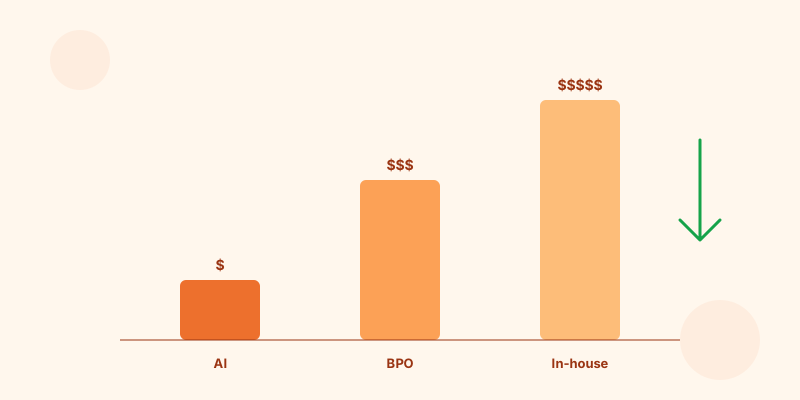
The headline question every support leader asks: what does it actually cost? Here's the per-call math for 2026 across three staffing models, on a typical 100,000-minute/month tier-1 support operation.
The three models
- In-house support team: 12 FTEs at $55K loaded each = $660K/year.
- BPO outsourced: $1.10 to $1.40/minute fully loaded = $1.32M to $1.68M/year.
- AI customer service (Phone Stack): at this volume you'd be on an Enterprise plan with rates around $0.18 per minute, roughly $216K/year.
For 100,000 minutes/month:
| Model | Annual cost | Per-call cost (5-min avg) |
|---|---|---|
| In-house | $660K | $5.50 |
| BPO | $1.32M–$1.68M | $11–$14 |
| AI customer service | ~$216K | ~$0.90 |
The hidden costs people miss
In-house and BPO numbers above are loaded: they include benefits, supervision, QA, training, attrition. The full picture is usually 30 to 50% above raw wages.
AI doesn't have those. The subscription price plus any per-extra-minute charges is the all-in cost.
Quality holds up
Industry data on tier-1 cases (order status, FAQs, returns, account updates) shows AI CSAT ≥ human CSAT, primarily because there's no hold time, no transfer chain, and no script-reading flatness. Frustration only spikes when AI refuses to escalate, which is why every Phone Stack deployment honors "let me speak to a human" instantly.
The hybrid math
Most operations don't go 100% AI. They push tier-1 to AI and reassign humans to tier-2 escalations, QA, and customer success expansion. The net headcount drop is typically 30 to 50%, not 100%. But the cost drop on the volume that does move is 80 to 90%.
When NOT to use AI customer service
- Very low volume (under 10,000 minutes/month): savings don't justify setup time.
- Pure-empathy work (bereavement, complex disputes): keep humans.
- Highly regulated voice work where AI rules are unclear (some healthcare scenarios).
Try the math
Run a 30-day pilot on one use case. See AI Customer Service for setup. Most teams see 80 to 90% cost reduction and equal/better CSAT inside week 2.